A finished AI track can sound impressive for thirty seconds and still fail a careful Suno sound quality check. The useful test is not whether the chorus is loud or glossy; it is whether the vocal stays clear, the low end behaves, the artifacts stay out of the way, and the export remains listenable after repeated plays.
The first listen should be boringly honest
Start with one full listen and do not touch a processor while it plays. Write down the exact time of every moment that bothers you: a metallic vowel, a blurry kick, a strange breath, a cymbal that turns into spray, a bass note that swallows the lyric. This first pass should be plain and a little unforgiving. If you start fixing too early, you will treat symptoms without knowing which problems actually matter.
Keep the playback level moderate. Loud playback makes almost everything feel more exciting, and it can hide the difference between energy and harshness. A practical quality control note sounds specific: "2:14, chorus vocal gets grainy on the word stay" is useful; "top end bad" is not. Specific notes let you repair only the bad moments instead of dulling the whole master.
After the first pass, group the notes into three buckets: performance artifacts, mix balance, and export problems. Performance artifacts include warped consonants or synthetic backing voices. Mix balance covers low-end blur, buried vocals, or harsh cymbals. Export problems include clipping, codec smear, or a file that looks suspiciously damaged in a spectrogram. The buckets keep the checklist from becoming a vague complaint list.
Check fatigue before volume
Listening fatigue is one of the clearest signs that a track needs repair before mastering. A song can be technically bright without being painful, but AI shimmer often has a restless edge that keeps tapping the ear. If the first minute feels fine and the second minute makes you turn the track down, do not solve it by lowering the whole master. Find what is causing the fatigue.
Common causes are narrow high-mid resonances, sibilance that was boosted during mastering, cymbal wash that never decays, and dense background vocals fighting the lead. Check the chorus first, then the bridge or breakdown where fewer sounds should make defects easier to hear. If harshness disappears when the vocal is muted, repair the vocal. If it stays, look at drums, synth layers, or the master bus.
Use small moves. A light de-esser, a narrow EQ dip, or a short spectral repair can solve more than a heavy denoise preset. Heavy processing may make the track quieter and smoother for a few seconds, then reveal a dull, underwater quality on the next listen. The checklist should reward comfort, not just silence.
What headphones reveal and what they hide
Suno headphones checks are valuable because they expose tiny vocal glitches, stereo imbalance, clicks, and reverb tails that small speakers may blur together. Closed-back headphones can make mouth noises and harsh consonants obvious. Open-back headphones can reveal whether the top end feels natural or sprayed across the stereo field. Use whichever pair you know well, and keep the volume steady.
Headphones also exaggerate some problems. A bass that feels weak in headphones may be fine on speakers, while a wide pad that sounds lush in headphones can disappear in mono. Do not let one pair decide the whole repair. Use headphones for detail work, then step away and check the emotional balance on speakers. The lead vocal should make sense without needing a microscope.
Pay attention to the center image. If the vocal moves sideways on certain syllables or the snare collapses when summed to mono, the issue may be phase or stereo processing rather than simple loudness. Mono compatibility is not glamorous, but it catches many finished AI tracks before they sound hollow on phones and compact speakers.
Use small speakers for vocal balance
A small speaker test is brutally useful. It removes much of the deep bass and forces the midrange to carry the song. If the lyric disappears, the kick masks the vocal, or the chorus turns into a narrow buzz, the track is not ready. This is where vocal intelligibility matters more than polish.
Do not fix the small speaker version alone. Use it to identify a balance problem, then return to the mix or repaired master. Sometimes the answer is a tiny vocal lift. Sometimes it is reducing a low-mid buildup in the instrumental. Sometimes a backing vocal stem is carrying hum or synthetic vowel noise that competes with the lead. The small speaker does not tell you the whole truth, but it tells you whether the song survives ordinary playback.
| Check | Passes when | Repair clue |
|---|---|---|
| Headphones | Clicks, sibilance, and reverb tails stay controlled | Use targeted edits before broad denoise |
| Small speaker | Lead vocal remains understandable | Adjust midrange balance before more loudness |
| Mono | Vocal, snare, and bass keep their position | Inspect stereo wideners and phasey stems |
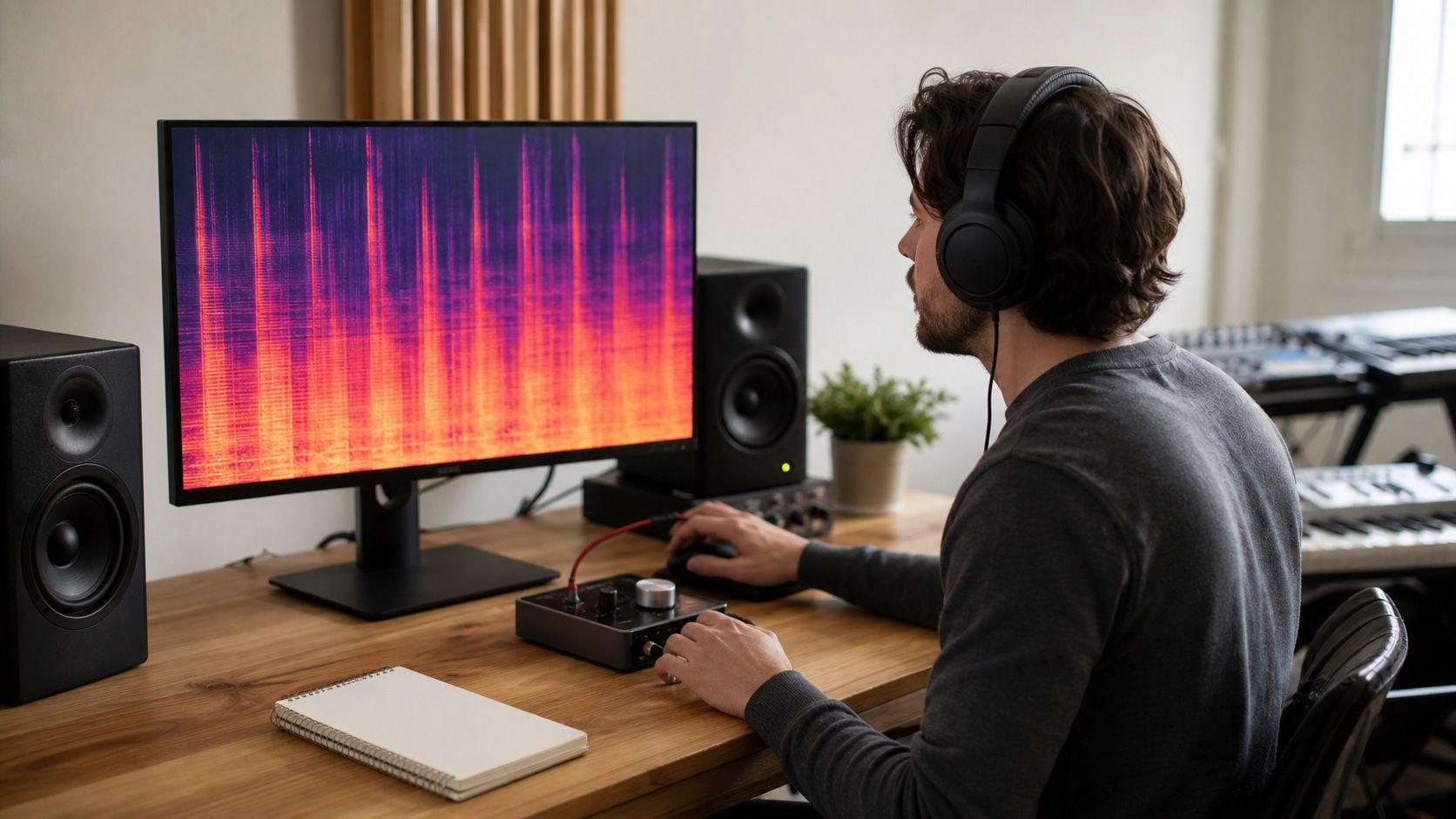
| Spectrogram | No new clipped blocks or constant noise carpet | Back off limiter or revisit artifact repair |
Keep a short repair log
A repair log sounds fussy until you need to undo a bad decision. Keep it short: source file, repaired mix, master version, loudness note, export format, and three defects fixed. If you used a de-esser, limiter, spectral repair, or sample-rate conversion, write down the order. That is enough to explain why one version sounds cleaner than another.
The log also prevents circular work. Many finished tracks get worse because the same problem is processed three different ways: a bright EQ boost to add air, a de-esser to calm the boost, then a limiter that pulls the noise forward again. With notes, you can see the loop and choose the cleaner move. Repair first, balance second, loudness third, export last.
The final checklist is simple: no obvious artifacts in the exposed vocal, no harsh fatigue after two listens, no low-end blur hiding the lyric, no mono collapse, no suspicious export damage, and a lossless archive saved before MP3 sharing. When those checks pass, the track may still have the fingerprint of AI generation, but it will sound controlled rather than unfinished.